

Second EDU Forum in Vilnius brought together the international educational research community
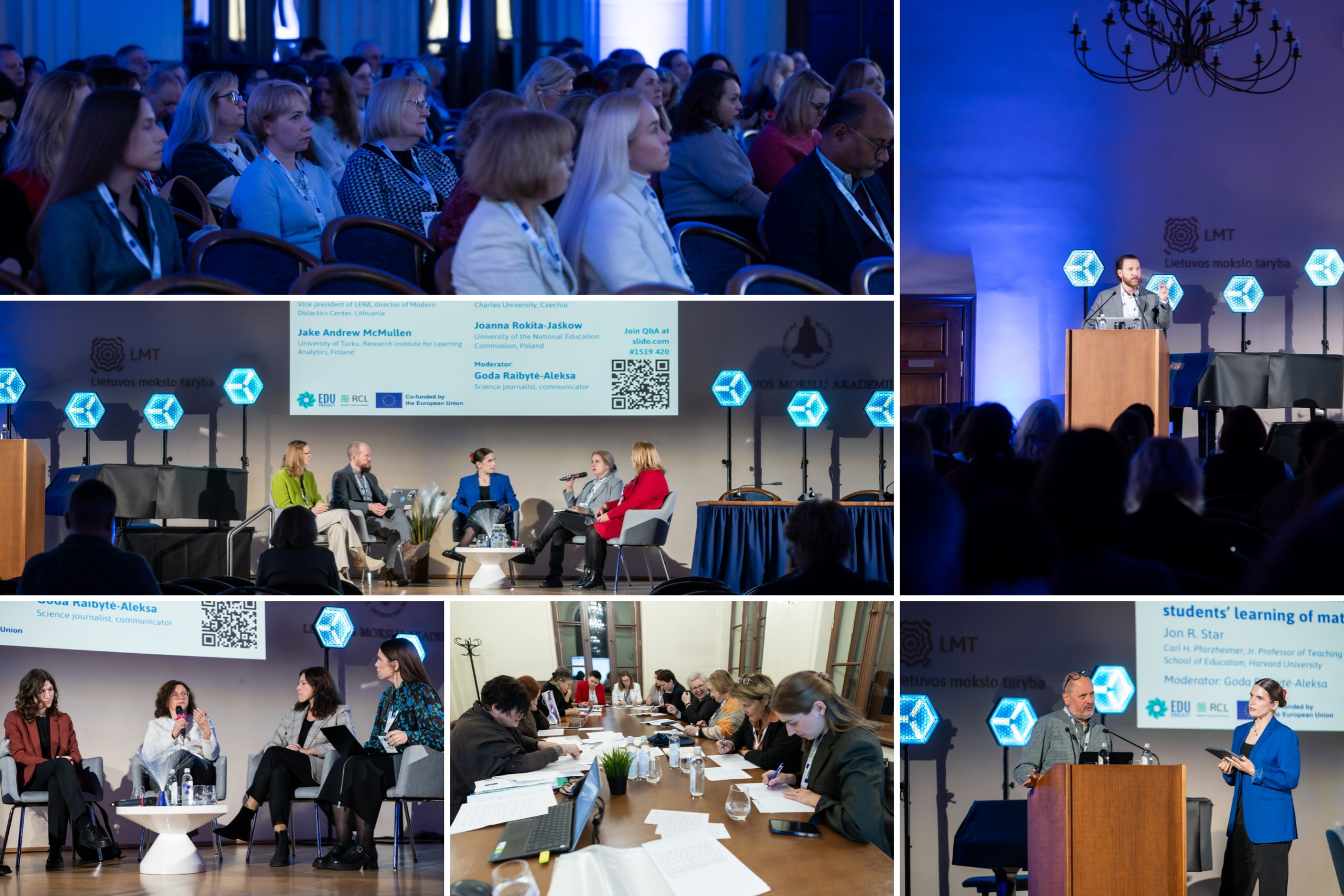
On 11–12 November, the Research Council of Lithuania (RCL) hosted the second EDU Forum, Global Perspectives in Educational Research. The event brought together Lithuanian and international researchers, education policymakers, teacher educators, school leaders and teachers to discuss how research can contribute to improving the quality of education and addressing contemporary educational challenges.
The two-day programme explored topics reflecting the rapidly changing educational landscape: the application of artificial intelligence in education, learning analytics, STEAM and science education, teachers’ professional development, inclusive education, student well-being, mathematical thinking and the assessment of educational quality. Participants attended presentations by international experts, presented their research findings in thematic sessions, and took part in discussions and practical workshops.
The forum’s plenary presentations placed particular emphasis on the interplay between research, education policy and practice. Dr Drew Story, former Director of the Massachusetts Institute of Technology (MIT) Policy Lab, presented practical recommendations for strengthening collaboration between education researchers, policymakers and teachers, and translating research findings into actionable evidence for decision-making. Professor Liudvika Leišytė of TU Dortmund University examined the evolution of teacher education systems, the relationship between competition and collaboration, and the impact of changes in educational governance on teacher education.
Associate Professor Mahsa McCauley of Auckland University of Technology discussed educational priorities in the age of artificial intelligence. She emphasised the importance of critical thinking, creativity and the ability to critically evaluate AI-generated information. Professor Jon R. Star of Harvard University introduced the concept of mathematical flexibility and its importance in developing students’ ability to select, compare and apply different problem-solving strategies.
During the thematic sessions, Lithuanian and international researchers shared insights into the application of artificial intelligence in schools, the potential of learning analytics, innovative teaching approaches, teachers’ professional learning, inclusion and education systems in times of uncertainty. Practical workshops allowed participants to explore specific research and teaching methods and their application in education. The forum also provided opportunities to establish new professional connections and explore shared interests.
Opening the forum, Professor Juozas Augutis, Acting Chair of the RCL, highlighted the need to strengthen the links between research, education policy decisions and everyday educational practice. He noted that addressing Lithuania’s educational challenges requires consistent, evidence-informed decisions and a deeper understanding of the country’s own education system. While international experience is valuable, the solutions it offers must be assessed within the Lithuanian educational context. He also emphasised that the significance of the EDU project should be assessed by its contribution to strengthening Lithuania’s long-term capacity to investigate educational challenges independently and systematically, and by the extent to which research findings inform education policy and practice.
The forum was organised as part of the RCL project Breakthrough in Educational Research (EDU project). It provided researchers involved in the project with an opportunity to present their work in an international context, discuss methodological issues directly with experienced international researchers and explore new opportunities for collaboration. Such exchanges are particularly valuable while research is underway, as insights from international experts can help assess methodological choices, refine research processes and identify new research directions.
The EDU project aims to strengthen Lithuania’s educational research capacity, enhance its international dimension and reinforce its alignment with the needs of the education system. The discussions at the forum reaffirmed that sustained dialogue between researchers, policymakers and practitioners is essential to building a foundation for long-term educational progress. Continued dialogue and the partnerships established at the forum can help ensure that research insights meaningfully inform educational decision-making in Lithuania.
The EDU Forum is a communication event organised as part of the project. The project ‘Breakthrough in Educational Research’ (No. 10-044-P-0001) is implemented under the Education Development Programme’s progress measure No. 12-003-03-06-01 ‘Teachers First’, administered by the Ministry of Education, Science and Sport of the Republic of Lithuania, the managing authority of the 2021–2030 Development Programme. The project is funded by the 2021–2027 European Union funds and the state budget of the Republic of Lithuania.
Last updated: 27-11-2026
Related news:
Lithuanian researchers invited to apply for NordForsk calls on women’s health and safe food research
Expert discussion: How is Lithuanian science strengthening national defence?
Lithuanian researchers are developing an AI-based solution to help older people live safely at home
Lithuania Co-Organises the GRC European Regional Meeting for the First Time