

„(re)SEARCH 2026“: mokslas tarp atvirumo, saugumo ir tarptautinės įtakos
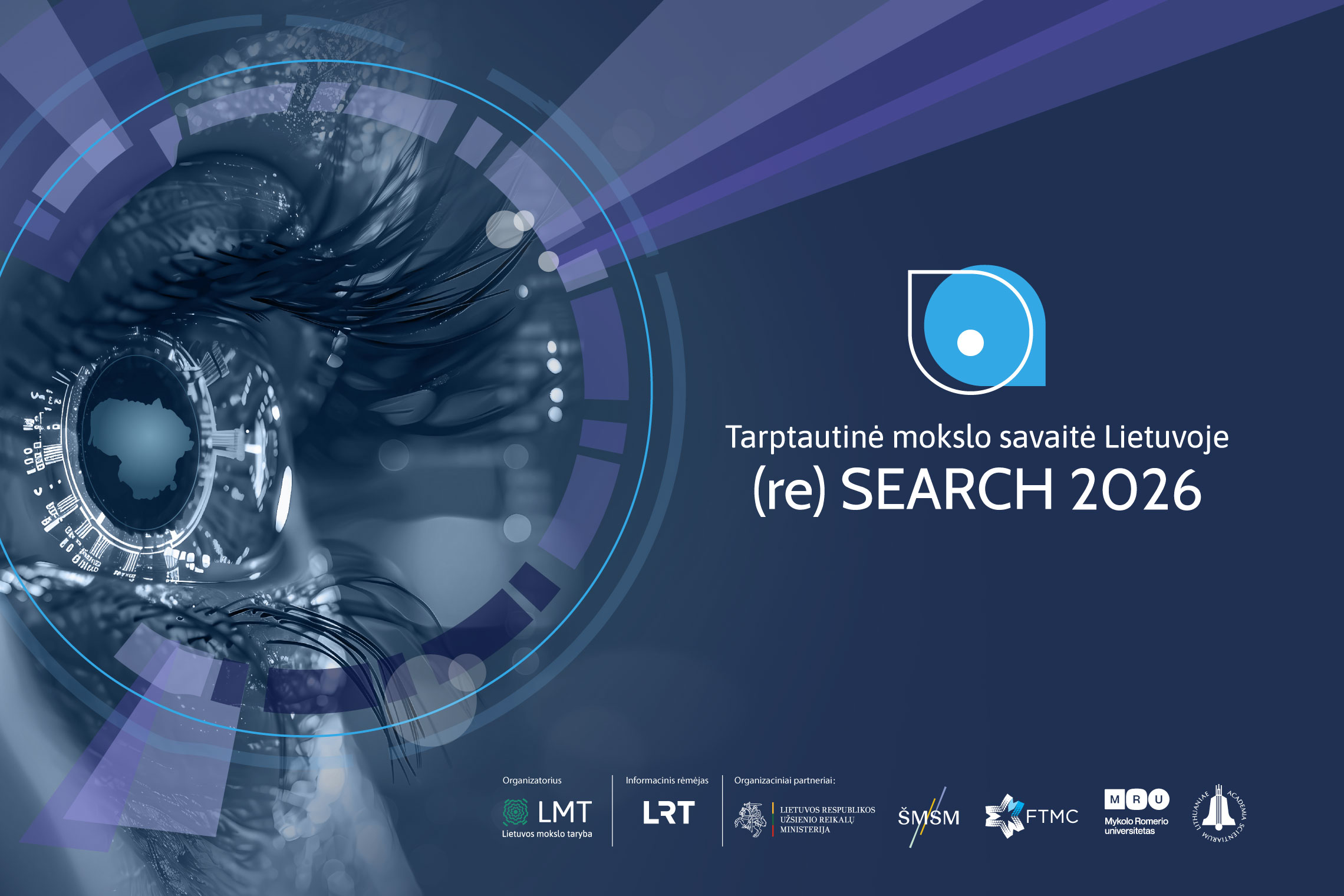
Technological competition, research security and science diplomacy have, in recent years, moved beyond the academic agenda to become integral parts of national foreign, economic and security policy. Taking place in Vilnius on 19–23 October, the international science week “(re)SEARCH 2026” will explore these issues through five distinct events bringing together scientific, policy, diplomatic and innovation communities from Lithuania and abroad.
This year’s context is particularly significant. Lithuania is preparing to hold the Presidency of the Council of the European Union in 2027, while Europe is simultaneously seeking answers to how it can preserve the openness of science amid growing geopolitical tensions, strengthen technological competitiveness, and protect strategically important knowledge and research infrastructure.
Last year, the inaugural “(re)SEARCH” week reached around 1,500 people in person and through live broadcasts, while its content reached tens of thousands more on social media. The atmosphere of the first edition, highlights from the events and insights from participants can be revisited in the 2025 “(re)SEARCH” video.
“Today, science is increasingly intertwined with national competitiveness, security, technological progress and international relations. Last year’s ‘(re)SEARCH’ week demonstrated that this conversation is relevant far beyond the scientific community – it attracted the attention of policymakers, businesses, the public sector and international partners. This year, we want to continue and broaden that dialogue, particularly as Lithuania prepares for its Presidency of the Council of the EU,” says Prof. Juozas Augutis, Acting Chair of the Research Council of Lithuania (RCL).
Science diplomacy: from concept to national interest
At the Lithuanian Science Forum on 20 October, science diplomacy will be explored as a practical instrument of state policy – one that can help build international partnerships, strengthen Lithuania’s position within the European Research Area, and provide researchers with access to international networks and research infrastructures.
The Forum will also address Lithuania’s position in the evolving European research policy landscape. The upcoming Presidency of the Council of the EU gives Lithuania an opportunity not only to help shape the European agenda, but also to raise issues that are important to Lithuania’s own research system – from international cooperation to research security and competitiveness.
This is also changing the way science diplomacy itself is understood. It increasingly extends beyond academic exchange to encompass the building of long-term relationships, trust and strategic partnerships.
When a scientific discovery needs to move beyond the laboratory
On 21 October, the Lithuania–U.S. Science and Innovation Forum will focus on how scientific knowledge is transformed into technologies, and how international cooperation can create the conditions for new technological partnerships and joint innovation projects.
The Forum will explore Lithuania–U.S. cooperation in biotechnology, laser technologies, space and other high-tech fields, as well as the conditions needed to translate scientific potential into competitive technologies and strengthen the scientific and technological capabilities of both countries.
The Lithuania–U.S. Science and Innovation Forum is organised by the Ministry of Foreign Affairs of the Republic of Lithuania, in partnership with the Center for Physical Sciences and Technology (FTMC).
Open science – but not without risks
On 22 October, an international conference will focus on research security and the management of geopolitical risks.
Openness, data sharing and international collaboration are essential to modern science. At the same time, certain knowledge, technologies and research infrastructure may carry not only academic, but also economic or strategic value. Universities, research centres and public institutions therefore increasingly face the challenge of maintaining an open research environment while responsibly managing the risks associated with it.
The conference will examine this challenge through practical issues, including institutional responsibilities, risks related to international partnerships, the protection of sensitive data and technologies, and resilience to geopolitical pressure.
A decade of Lithuania–Japan scientific partnership
“(re)SEARCH 2026” will open on 19 October with an event marking the 10th anniversary of the Lithuania–Japan scientific cooperation programme.
This cooperation provides an opportunity to view international scientific partnerships from a longer-term perspective. Their value is measured not only by the number of joint projects, but also by whether lasting relationships between researchers develop over time, whether new areas of joint research emerge, and whether cooperation can continue beyond a single funding cycle.
The week will conclude on 23 October with a lecture by Prof. Vytautas Nekrošius, “The Constitution as a Value”, adding perspectives on law, the state and values to the “(re)SEARCH 2026” programme.
Five days of “(re)SEARCH 2026”
- 19 October – Event marking the 10th anniversary of the Lithuania–Japan scientific cooperation programme
- 20 October – Lithuanian Science Forum, “When Science Builds Bridges”
- 21 October – Lithuania–U.S. Science and Innovation Forum
- 22 October – Conference, “An Interdisciplinary Approach to Research Security for Managing Geopolitical Risks and Building a Resilient Society”
- 23 October – Lecture by Prof. Vytautas Nekrošius, “The Constitution as a Value”
Detailed information about the “(re)SEARCH 2026” events is available here.
The international science week “(re)SEARCH 2026” is organised by the Research Council of Lithuania (RCL).
Organisational partners: the Ministry of Education, Science and Sport of the Republic of Lithuania, the Ministry of Foreign Affairs of the Republic of Lithuania, the Center for Physical Sciences and Technology (FTMC), Mykolas Romeris University, and the Lithuanian Academy of Sciences.
Media partner – LRT.
Atnaujinimo data: 2026-08-17
Taip pat skaitykite:
Neatrasti devyniasdešimtųjų pasakojimai: ką atskleidžia alternatyvios jaunimo kultūros tyrimas
Sutemus miestas sukuriamas iš naujo: ką apie jo prioritetus atskleidžia dirbtinė šviesa?
LMT „Ką sako mokslas?“: neuromokslininkė dr. Laura Bojarskaitė – kaip DI keičia mūsų smegenis?
Europa stiprina retųjų ligų tyrimus: naujos galimybės Lietuvos tyrėjams ir inovatoriams