

G. Urbonas: Lithuania Can Not Only Participate in International Research Networks, but Also Initiate Them
Lithuanian researchers work at some of the world’s leading universities, participate in international projects and build connections with influential research institutions. Yet international visibility alone does not translate into influence. How can the individual success of researchers and institutions be transformed into long-term science diplomacy capital for Lithuania? And what is needed for Lithuania not only to join international networks created by others, but also to bring partners together and help shape the agenda?
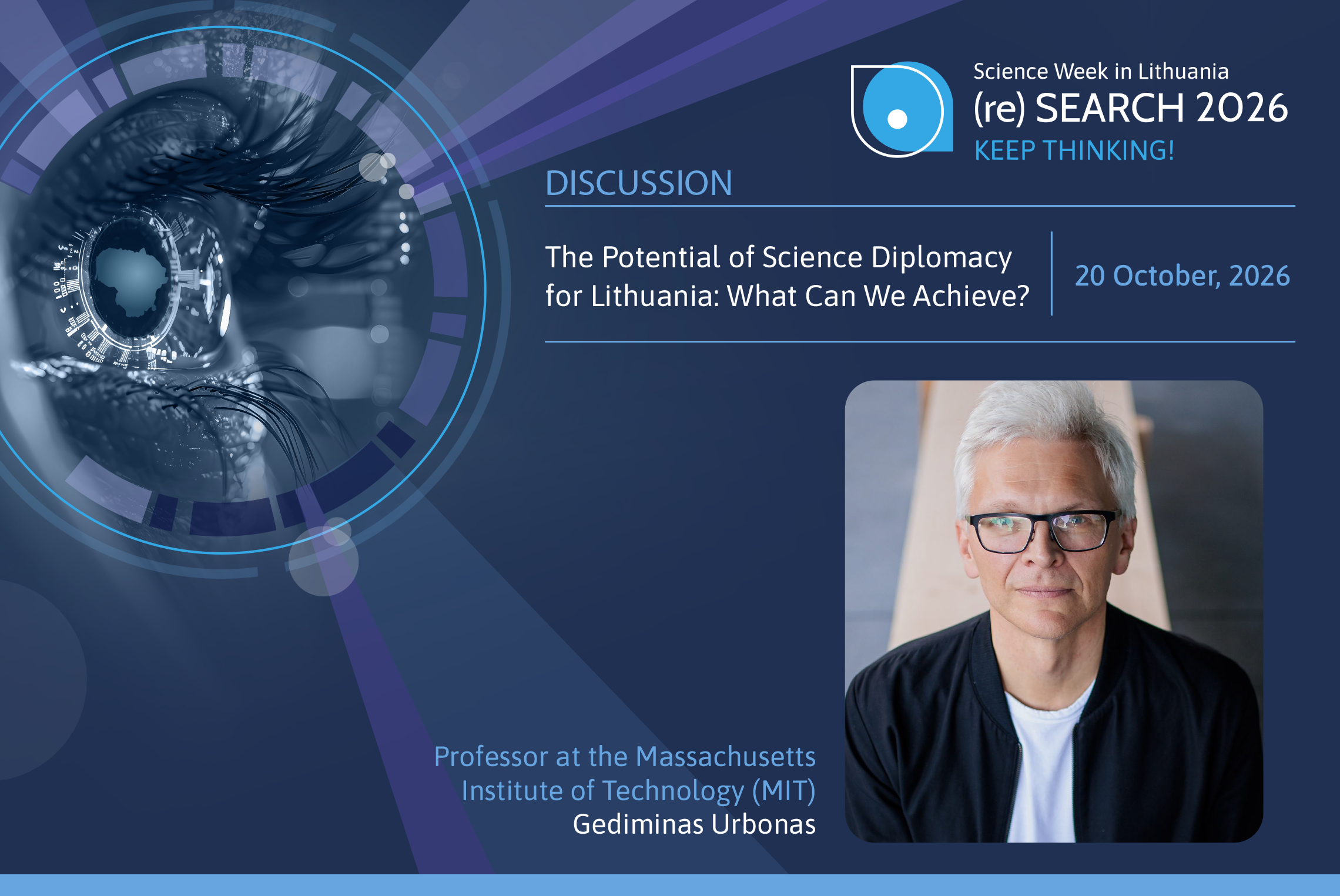
These questions will be addressed on 20 October at the Lithuanian Science Forum When Science Builds Bridges, organised by the Research Council of Lithuania (RCL) as part of the International Science Week in Lithuania (re)SEARCH 2026. During the forum discussion The Potential of Science Diplomacy for Lithuania: What Can We Achieve?, representatives of the research and academic communities and public policy will explore Lithuania’s opportunities to strengthen its role in the international research landscape and the long-term decisions needed to realise this potential.
One of the participants in the discussion, Massachusetts Institute of Technology (MIT) Professor Gediminas Urbonas, emphasises that a small country’s influence in the international research landscape is not determined solely by its size or by the scale of its institutions or investment. The essential question is which globally significant challenges a country is prepared to address and whether it can build strong international partnerships around them.
“A small country’s influence is determined not by the scale of its institutions or investment, but by its ability to clearly articulate which globally significant challenges it is prepared to address and to build strong international partnerships around them. Visibility comes from participation, while influence comes from initiating new endeavours, cultivating trust and becoming a reliable partner,” says G. Urbonas.
Visibility Is Not Yet Influence
In the international research landscape, what matters is not only participating in projects or networks, but also being present where new questions are raised, initiatives emerge and long-term partnerships are built. For a small country, this means clearly identifying the areas in which it can offer internationally significant expertise and a distinctive perspective.
Having worked for many years across international academic, artistic and research networks, G. Urbonas, whose initiative helped launch cooperation between MIT and Lithuanian institutions, sees Lithuania’s potential primarily in its ability to bring people and organisations together. In his view, the greatest impact is often created not by the largest institutions, but by those capable of crossing disciplinary and sectoral boundaries. Today, breakthroughs occur where science, technology, the arts, the humanities and social sciences, public policy and the knowledge of local communities intersect.
“We are small enough to build connections quickly between universities, public institutions, business, culture and the diaspora, yet we have enough strong researchers and creators to propose initiatives of international significance,” says G. Urbonas.
In his view, Lithuania’s geographical and historical position also gives the country a distinctive perspective on the resilience of democratic societies, ecological transformation, technology ethics, security and regional cooperation. Lithuania therefore need not attempt to replicate the models of larger countries – its scale can become an advantage in defining a distinctive role in the international research landscape.
“Lithuania could become an experimental space where new ideas are not only discussed but also tested under real-world conditions. For international partners, such a country becomes not a periphery, but a laboratory and a trusted co-creator,” says G. Urbonas.
Individual Success Must Become a Broader Asset for Lithuania
Another important question in science diplomacy is how the international connections already established by Lithuanian researchers and institutions can be transformed into a long-term strength for the country as a whole.
The international careers of Lithuanian researchers, their membership in strong networks and participation in joint projects open up significant opportunities. However, according to G. Urbonas, these achievements do not in themselves constitute science diplomacy. For that to happen, the experience, connections and trust accumulated by individuals must extend beyond a single person or project.
“They become diplomatic capital when the experience, trust and connections gained internationally flow back into Lithuania’s broader ecosystem – for example, by opening doors for other researchers, students and institutions and helping to develop new programmes and shared infrastructures,” emphasises G. Urbonas.
Through his work to strengthen ties between MIT and Lithuania, he has seen that international partnerships begin with specific individuals but cannot remain dependent solely on their personal energy. For a connection established by one researcher to become an opportunity for a broader community, institutional continuity is essential – coordination, long-term funding, regular exchanges, joint research programmes and other mechanisms that support sustained cooperation.
“A one-off visit can create visibility, but reputation is built through reliable cooperation sustained over many years,” says G. Urbonas.
The Lithuanian diaspora also has an important role to play in this process. According to G. Urbonas, Lithuanians working at universities and research centres abroad should be seen not only as individually successful professionals, but also as a network of knowledge, trust and institutional connections. This, however, requires a two-way relationship – clear opportunities for cooperation, professional administrative support and shared long-term objectives.
“Science diplomacy is not simply about communicating a country’s image. It is about the ability to offer international partners trusted people, knowledge, infrastructure and a long-term political and institutional commitment to working together,” emphasises G. Urbonas.
From Participation to Shaping the Agenda
The next level of ambition for Lithuania’s science diplomacy is not merely to be part of international networks, but to initiate new forms of cooperation itself. In G. Urbonas’s view, Lithuania could bring partners together to address challenges that are only beginning to emerge on the international agenda.
This does not require covering every field of research. What matters more is selecting several themes of strategic importance to both Lithuania and the wider world, building a critical mass of expertise around them and giving institutions the mandate to work with a long-term perspective.
One ambition of the MIT–Lithuania Consortium could be to develop an international Baltic regional platform bringing together science, technology, design, the arts and public policy to strengthen democratic, ecological and technological resilience. By combining the knowledge and experience of Lithuanian institutions and MIT, we could develop joint research and test new models of cooperation, climate adaptation, responsible technology development and public engagement in practice.
This would make it possible to view the Baltic region not only through the lens of geopolitical vulnerability, but also as a place where solutions relevant to other countries are developed. Lithuania could take on the role of initiator and host, while the Consortium could help formulate shared questions, bring partners together and ensure long-term cooperation.
Such an ambition, however, cannot be achieved through individual projects or conferences alone. G. Urbonas stresses the need to move from project-based thinking towards an infrastructure-based approach: international influence is built through permanent exchange programmes, joint laboratories, long-term institutional agreements, international doctoral programmes, researcher and student mobility, and spaces where different forms of knowledge can meet on equal terms. At the heart of this approach is the trust built over time between people and institutions.
“I understand science diplomacy as an infrastructure of trust. It is built patiently, through working together, mutual commitment and the ability to listen. Lithuania’s ambition could be not only to take a seat more often at existing tables, but to create tables around which others would want to gather. We have both the expertise and the international connections to do this. Now we need to bring them together into a coherent, long-term national strategy,” says G. Urbonas.
The Lithuanian Science Forum When Science Builds Bridges will take place on 20 October at the Research Council of Lithuania, Gedimino Ave. 3, Vilnius. G. Urbonas will participate in the forum discussion The Potential of Science Diplomacy for Lithuania: What Can We Achieve?, which will explore Lithuania’s opportunities to strengthen science diplomacy, build international partnerships and play a more active role in shaping the international research agenda.
The Forum will also be broadcast live on LRT PLIUS.
Full programme and registration: scienceweek.lt
Photo by Edvardas Blaževič
Last updated: 30-09-2026
Related news:
Lithuanian Universities’ Global Networks: How Can They Become a Strategic Asset for the Country?
More Trees in the City – Cleaner Air? According to a Researcher, It’s Not That Simple
RCL delegation explores Finland’s experience with flagship research programmes
Lithuanian Academy of Sciences and Research Council of Lithuania Sign Memorandum of Cooperation
V. Nekrošius: The Essence of the Constitution Lies Not Only in Rules, but Also in Values