

V. Nekrošius: The Essence of the Constitution Lies Not Only in Rules, but Also in Values
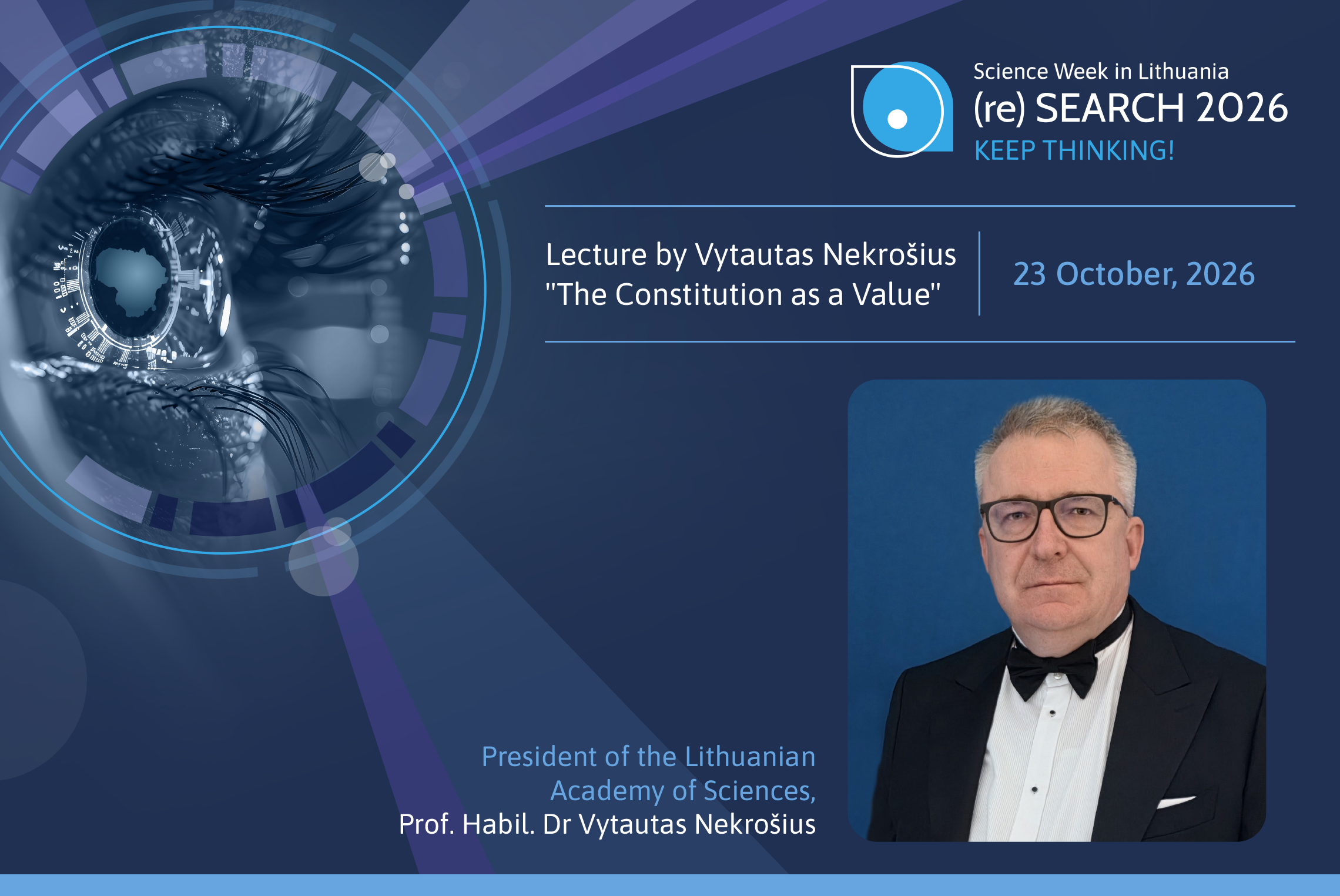
What is a Constitution – the supreme legal act of a state, or something far more? President of the Lithuanian Academy of Sciences, Academician Professor Habil. Dr Vytautas Nekrošius, argues that a purely legal definition is not enough. A Constitution enshrines the fundamental values agreed upon by the nation and provides the foundation for life together within the state. Its essence, therefore, should be sought not only in the rules set down in writing.
V. Nekrošius will explore this perspective on the Constitution on 23 October in his lecture The Constitution as a Value, held as part of International Science Week in Lithuania “(re)SEARCH 2026”.
According to Professor Nekrošius, understanding the Constitution as the supreme legal act of the state primarily defines its place within the hierarchy of legal norms. However, this alone is not enough to understand its essence, its deeper significance, or its relationship with the nation as the holder of sovereignty.
“Both in the jurisprudence of the Constitutional Court and in philosophical doctrine, the Constitution is regarded as a social contract concerning the organisation of the state. In the Constitution, the nation first and foremost enshrines the fundamental values that are to guide the state. These values form the foundation of the organisation of the state and of society’s life together,” says V. Nekrošius.
For this reason, he argues, viewing the Constitution solely as the legal act of the highest authority would clearly be too narrow an approach.
How Does the Constitution Remain a Living Document?
The values enshrined in the Constitution must provide the state with a firm foundation, yet society itself is not static. The way people live changes, and the law evolves alongside it. How, then, can these two dimensions be reconciled – the stability of the Constitution’s fundamental values and its ability to remain relevant?
V. Nekrošius points out that the Constitution enshrines society’s most fundamental and, at the same time, most universal values. Some of them – such as inherent human rights – do not change. This does not mean, however, that the law can be detached from changes taking place within society.
“It is natural for society to change, and therefore the law cannot remain unchanged either. Of course, there are inherent human rights and other fundamental values that do not change. This process is ensured through the work of the Constitutional Court, which guarantees the vitality and dynamism of the Constitution,” says Professor Nekrošius.
It is precisely in this relationship between what endures and what changes that the significance of the Constitution as a living foundation of the state becomes apparent.
An Agreement on What Matters Most to the State
The value-based significance of the Constitution becomes particularly clear when we look beyond its individual provisions and consider what forms the foundation of life together within the state and society. According to V. Nekrošius, the Constitution should first and foremost be understood as a shared foundation of values.
“The Constitution should primarily be regarded as a common foundation of values – a set of values that the nation agreed upon as the basis of the state when voting for the Constitution. It reflects the fundamental principles of social life and the functioning of the state,” says V. Nekrošius.
Professor Nekrošius emphasises that it is these values, rather than merely the written rules, that form the Constitution’s value-based foundation and reveal its true essence.
More information and registration for this event and other “(re)SEARCH 2026” events are available here.
The event is part of the programme of International Science Week in Lithuania “(re)SEARCH 2026”. LRT is the media partner of “(re)SEARCH 2026”.
Last updated: 22-09-2026
Related news:
RCL delegation explores Finland’s experience with flagship research programmes
“Science Summer with RCL”: Young Researchers Presented Their Research Results
“(re)SEARCH 2026”: Science at the Intersection of Openness, Security and International Influence
After Dark, the City Is Created Anew: What Does Artificial Light Reveal About Its Priorities?