

Lithuanian Universities’ Global Networks: How Can They Become a Strategic Asset for the Country?
Lithuanian Universities’ Global Networks: How Can They Become a Strategic Asset for the Country?
How can science help Lithuania build lasting international partnerships, strengthen its position on the global stage and bring partners together around shared goals? These questions will be explored by representatives of the Lithuanian and international research, policy and diplomatic communities at the Lithuanian Science Forum, “When Science Builds Bridges”, on 20 October. One of the forum’s central themes will be science diplomacy and its potential for Lithuania.
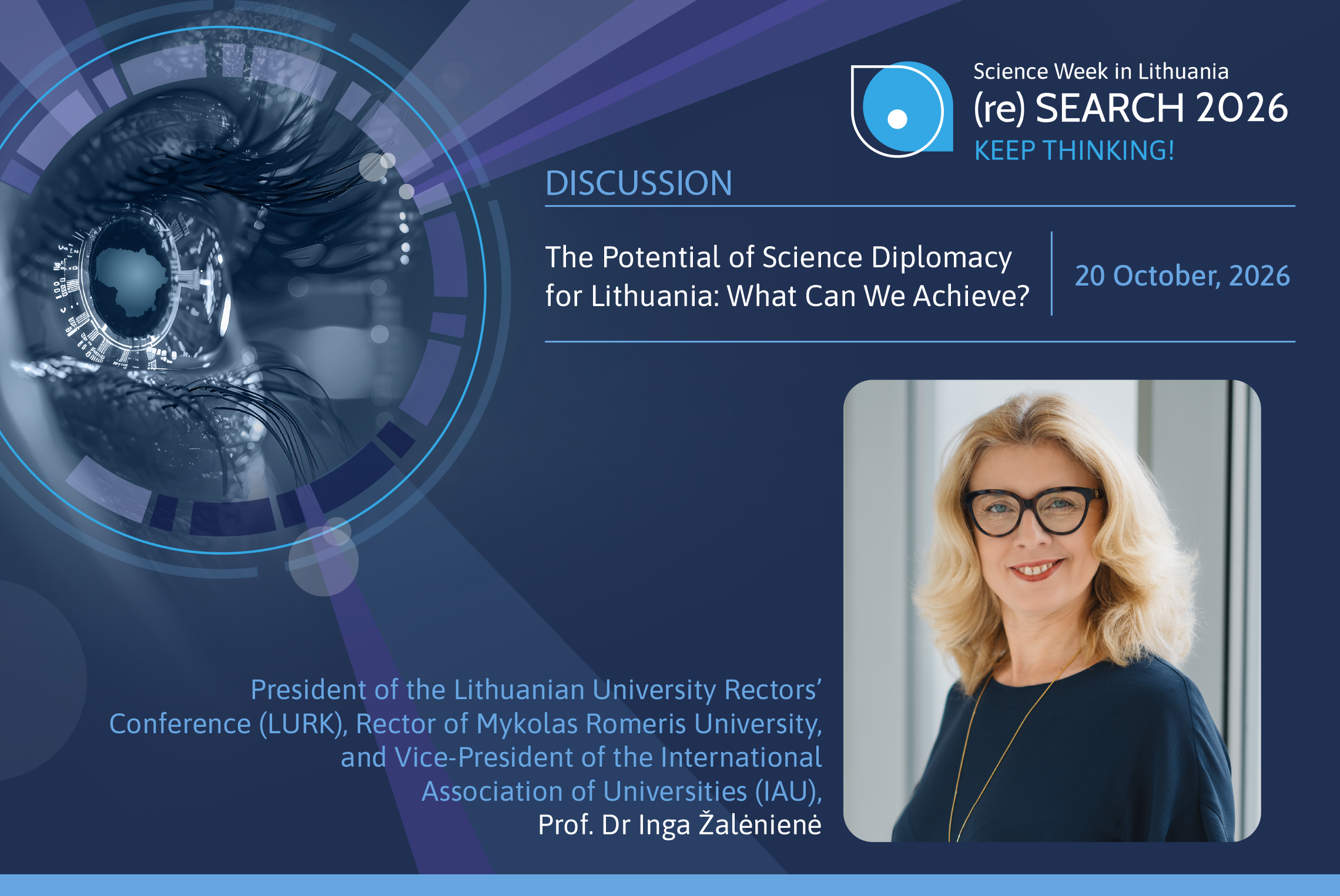
Among the participants in the discussion “The Potential of Science Diplomacy for Lithuania: What Can We Achieve?” will be Prof. Dr Inga Žalėnienė, President of the Lithuanian University Rectors’ Conference (LURK), Rector of Mykolas Romeris University (MRU) and Vice-President of the International Association of Universities (IAU). She draws attention to a valuable resource Lithuania already possesses but has yet to fully leverage strategically: the extensive network of international relationships and partnerships developed by its universities.
Lithuanian universities participate in international networks and alliances, conduct joint research, establish long-term institutional partnerships and attract students and researchers from abroad. According to Prof. Žalėnienė, however, it is time to go further and recognise these connections not merely as achievements of individual universities, but as a resource for Lithuania’s science diplomacy – one that can strengthen the country’s international reputation, strategic partnerships and long-term influence.
– Science diplomacy is often discussed as part of a country’s foreign policy. Where do universities fit into this picture?
– I believe universities are now among the most important pillars of Lithuania’s science diplomacy infrastructure. They do not simply reflect Lithuania’s reputation abroad – they actively shape it every day.
Science diplomacy takes place whenever a Lithuanian researcher undertakes a joint project with an international colleague, whenever a Lithuanian university joins an international network, whenever a student from abroad chooses to study in Lithuania, or whenever one of our experts is invited to contribute to an international scientific debate or help shape the agenda of an international organisation. It also takes place when Lithuanian universities host international scientific conferences and forums bringing together academic communities from across Europe and the world.
We see this clearly in the experience of Mykolas Romeris University. We began developing partnerships with countries in the distant Indo-Pacific region 20 years ago, at a time when Lithuania had only one embassy operating in the region.
MRU’s longstanding partnership with Dongseo University in South Korea is much more than an academic exchange initiative. Joint degree programmes and the King Sejong Institutes operating at MRU and Vytautas Magnus University (VMU) foster not only sustainable partnerships between academic communities, but also greater intercultural understanding and mutual trust between the two countries.
The Australia–Lithuania Cybersecurity Network, established by MRU in cooperation with RMIT University in Australia, strengthens not only our expertise but also Lithuania’s international visibility in a field directly linked to national security.
Academic ties with Japanese universities, close partnerships with European institutions, participation in European university alliances and international academic networks – all of these contribute to building sustainable and mutually beneficial relationships.
Universities have the ability to connect actors that institutional structures sometimes struggle to bring together: academia, business, the public sector and international partners. This is a diplomatic asset whose value should not be underestimated.
– Lithuanian universities have already established extensive international networks. Is Lithuania making sufficient use of this capital at the national level?
– First and foremost, we need to recognise that universities’ international relationships are not assets belonging solely to the institutions themselves. They are also an asset for Lithuania as a whole.
When we establish a long-term partnership with a foreign university, Lithuania’s visibility in that country grows as well. When an international student comes to Lithuania, they discover not only our university, but Lithuania itself.
I would describe international students, lecturers and researchers as ambassadors for Lithuania in their own right. They take with them their experiences, relationships and understanding of our country. Even after completing their studies, many remain connected to Lithuania as partners in business, research, the public sector or diplomacy.
Yet we could make much better use of this potential. We need to develop an ecosystem for strategic coordination between universities, public institutions and the research and innovation system.
Universities do not need identical internationalisation strategies. Quite the opposite – we should build on their individual strengths, areas of specialisation and distinctive profiles. However, wherever universities’ academic interests can serve Lithuania’s broader national interests, we should act together.
– What practical difference would closer coordination between universities and the state make?
– First, it would allow us to make more effective use of Lithuanian universities’ international partnerships as an instrument of the country’s soft power.
A partnership with a university in Europe, Asia, the Americas, Africa or Australia is about much more than a scientific publication, joint research or the exchange of researchers and students. It creates a network of long-term relationships that can also extend into the fields of economics, innovation, security and diplomacy.
We should also take a more systematic approach to engaging our alumni. International students who have studied in Lithuania represent an exceptionally valuable global network. Five, ten or twenty years later, they may become leaders of universities, businesses, public institutions or international organisations, or hold influential positions within them. Maintaining relationships with our alumni is a long-term investment in Lithuania’s international relations.
Of course, we must also invest in the foundations that make these partnerships possible: international study programmes, joint research, the mobility of academic staff, researchers and students, doctoral education and the attraction of international talent.
Investment is equally important in promoting Lithuanian universities abroad, participating in education fairs and international higher education exhibitions. If we want to maintain the competitiveness of Lithuanian universities, Lithuania itself and Europe as a whole, we must invest adequately in these activities.
Internationalisation should not be merely a statistical indicator of university performance. It must become part of Lithuania’s long-term international capital.
– Which strengths of Lithuanian universities are currently underutilised on the international stage?
– I believe one such strength is the ability of Lithuanian universities to bring together partners who share our commitment to important values and solutions.
Our history and the current geopolitical environment have given us valuable experience. Lithuanian universities are not neutral observers of developments in our region. We understand the significance of freedom, democracy, academic autonomy, the rule of law and societal resilience.
Our support for Ukraine has demonstrated this particularly clearly. Universities have provided, and continue to provide, assistance to victims of Russian aggression, people displaced by the war, and Ukrainian students and researchers. They are developing academic partnerships and contributing to discussions on democratic resilience, law, security and state-building. This is not merely an expression of solidarity – it is also science diplomacy in practice.
Another strength lies in our ability to work across disciplinary and national boundaries. Cybersecurity and societal resilience, for example, are areas in which we can bring together the expertise of universities from Europe, Asia and other regions.
We can build international university networks around issues of strategic importance to Lithuania: security, societal resilience, the protection of democracy, the rule of law, artificial intelligence governance, Ukraine’s reconstruction and human rights.
This is where I see a very concrete task for science diplomacy: not only to promote Lithuanian research internationally, but also to share Lithuania’s experience and values-based expertise by building international networks capable of addressing common challenges.
– What would it take for Lithuania to become not only a trusted partner in the international research community, but also a country that brings others together?
– We need to be bolder in saying that Lithuania can do more than join international partnerships – it can initiate them.
We are a small country, but our leading universities are internationally engaged, flexible and capable of establishing partnerships quickly. This is one of our competitive advantages.
When a university establishes a relationship with an institution in a country of strategic importance to Lithuania, that relationship may begin with a joint research project or an academic exchange. Yet ten years later, it may have evolved into a much broader network spanning academia, innovation, business and even diplomacy, opening new international markets for Lithuanian businesses or creating opportunities for cultural cooperation.
That is why I see science diplomacy as a means of building lasting trust. Diplomacy often begins with a political meeting, while science begins with a question we want to answer together. In both cases, however, trust is fundamental.
This is precisely where Lithuanian universities have an essential role to play. We can build bridges where political relations sometimes become more complicated, bring people together around shared, knowledge-based solutions and, in doing so, steadily strengthen Lithuania and its standing in the world.
The Lithuanian Science Forum, “When Science Builds Bridges”, will take place on 20 October at the Research Council of Lithuania (Gedimino Ave. 3, Vilnius).
The forum is part of International Science Week in Lithuania, “(re)SEARCH 2026”, taking place in Vilnius on 19–23 October.
Registration for Science Week events is now open. Full programme details and registration are available at scienceweek.lt.
The forum will also be broadcast live on LRT PLIUS.
Interview by Ernesta Šneideraitytė, RCL
Photo courtesy of the interviewee’s personal archive
Media contact
Ernesta Šneideraitytė
Tel. +370 678 65 070
Email: [email protected]
Last updated: 09-10-2026
Related news:
More Trees in the City – Cleaner Air? According to a Researcher, It’s Not That Simple
RCL delegation explores Finland’s experience with flagship research programmes
Lithuanian Academy of Sciences and Research Council of Lithuania Sign Memorandum of Cooperation
V. Nekrošius: The Essence of the Constitution Lies Not Only in Rules, but Also in Values