

Lithuanian Science Invites You to Return: The Research Council of Lithuania and the Ministry of Foreign Affairs Are Building a Return Ecosystem
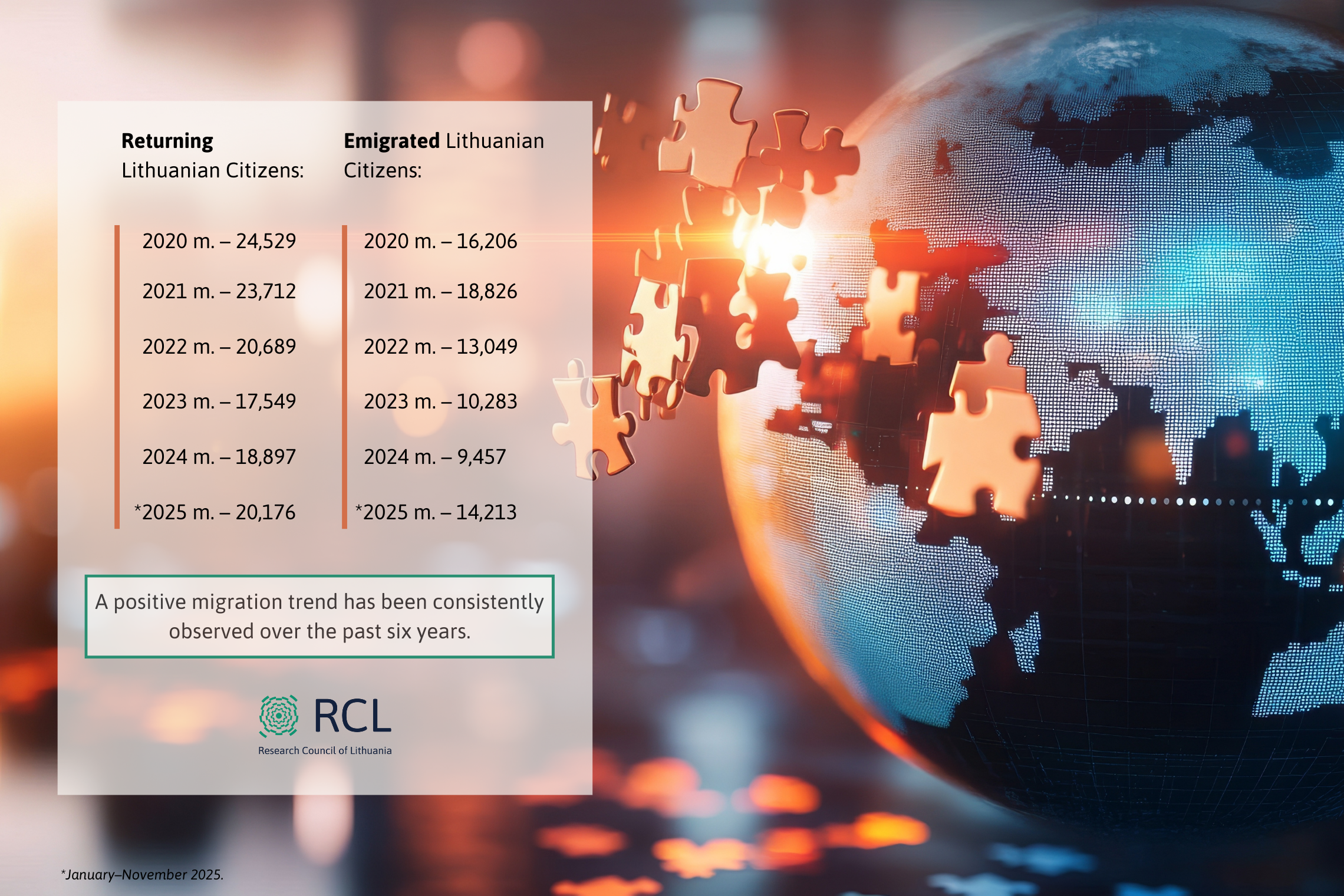
The Research Council of Lithuania (RCL) is strengthening ties with the Lithuanian diaspora and helping to promote return migration in response to a positive migration trend recorded for six consecutive years. According to the State Data Agency of Lithuania, more Lithuanian citizens are returning to the country than leaving. In 2025 (January–November), the number of returnees reached 20,176, compared to 14,213 departures.
RCL notes that the diaspora is an integral part of the national research ecosystem. The Lithuanian community dispersed across the globe represents a significant pool of human and intellectual potential, whose engagement in the country’s life contributes to the growth of science, innovation, culture, and the economy. Close cooperation with the Ministry of Foreign Affairs enables the targeted involvement of Lithuanians living abroad in Lithuania’s research landscape and, in many cases, encourages them to choose a path of return to their homeland.
Data from a diaspora survey commissioned by the Ministry of Foreign Affairs in 2024 reveal significant potential for return to Lithuania: as many as 22% of respondents living abroad plan to return, while a further 57% are considering this possibility. These trends confirm the need to continue developing and refining measures that encourage return, ensure smooth (re)integration, and create favourable conditions for Lithuanians living abroad to come back and contribute to the development of Lithuania’s science, culture, and economy.
“We see strong potential for return to Lithuania and a growing trend of people choosing to come back. To ensure that return and (re)integration are smooth and effective, we place particular emphasis on close inter-institutional cooperation. We welcome the strengthening partnership with the Research Council of Lithuania, which helps attract researchers working abroad, creates opportunities to continue research in Lithuania, and contributes to advancing the country’s science, innovation, and knowledge exchange,” says Vice-Minister of Foreign Affairs Sigitas Mitkus, underscoring the importance of cooperation with the RCL.
Institutional Meeting at the Ministry of Foreign Affairs Focuses on Counselling Returnees
At the annual inter-institutional meeting hosted by the Ministry of Foreign Affairs (MFA) on 3 December, representatives discussed cooperation among Lithuanian institutions in providing counselling to returning nationals. During the meeting, the Research Council of Lithuania (RCL) presented its initiatives aimed at supporting and bringing together the academic diaspora community.
“The diaspora is an integral part of Lithuania’s research system. Therefore, the Research Council of Lithuania is purposefully developing mechanisms that enable Lithuanian researchers working abroad to engage in Lithuania’s research landscape and to turn their return into a systematic opportunity for national growth,” says Dr Gintaras Valinčius, Chair of the RCL.
RCL’s Contribution to the Diaspora: Programs and Partnerships
RCL consistently implements initiatives aimed at strengthening ties between Lithuanians abroad and research in Lithuania:
- The Student Summer Research Internship Programme provides opportunities for Lithuanian students studying abroad to conduct research in Lithuania and maintain professional connections with researchers in the country.
- The Lithuanian Studies Research Programme supports applied research at centres of Lithuanian studies abroad, fostering international academic awareness of Lithuania.
- RCL participates in international science diplomacy initiatives, strengthening links between foreign researchers and Lithuania and helping to create pathways for return.
A Sustainable Partnership with the Ministry of Foreign Affairs: Strengthening Science Diplomacy
The partnership between RCL and the Ministry of Foreign Affairs in the area of the diaspora is of strategic importance and is being developed in a consistent and sustained manner. The two institutions work closely together both in shaping diaspora policy directions and in implementing initiatives that help maintain strong ties with Lithuanian researchers and students living abroad.
This cooperation has also naturally evolved into a platform for joint events. A clear example is the International Science Week “(re)SEARCH” held in 2025, whose programme was complemented by the Science Diplomacy Forum initiated by the Ministry of Foreign Affairs. The event demonstrated that combining scientific and diplomatic expertise can generate greater impact in engaging the academic diaspora.
Migration Trends: A Steady Rise in Return Migration
Statistics from the State Data Agency indicate a consistent shift: over the past six years, the number of Lithuanian citizens returning to the country has systematically exceeded the number of those leaving. This trend is also clearly evident in 2025, with return migration continuing to outpace emigration. This confirms that return migration is not a temporary fluctuation but a deliberate and well-established process.
An analysis of long-term data shows that emigration is declining at a faster rate than return migration, while the gap between those leaving and those returning is widening in a positive direction each year. This points to a sustainable, long-term change: Lithuania is becoming an increasingly attractive place for self-realisation, and the activities of public institutions — including RCL initiatives aimed at the academic diaspora — are contributing to the creation of an environment that supports this process.
Last updated: 16-12-2025
Related news:
Lithuanian Universities’ Global Networks: How Can They Become a Strategic Asset for the Country?
More Trees in the City – Cleaner Air? According to a Researcher, It’s Not That Simple
RCL delegation explores Finland’s experience with flagship research programmes
Lithuanian Academy of Sciences and Research Council of Lithuania Sign Memorandum of Cooperation