

RCL “What Does Science Say?”: Neuroscientist Dr Laura Bojarskaitė – How Is AI Changing Our Brains?
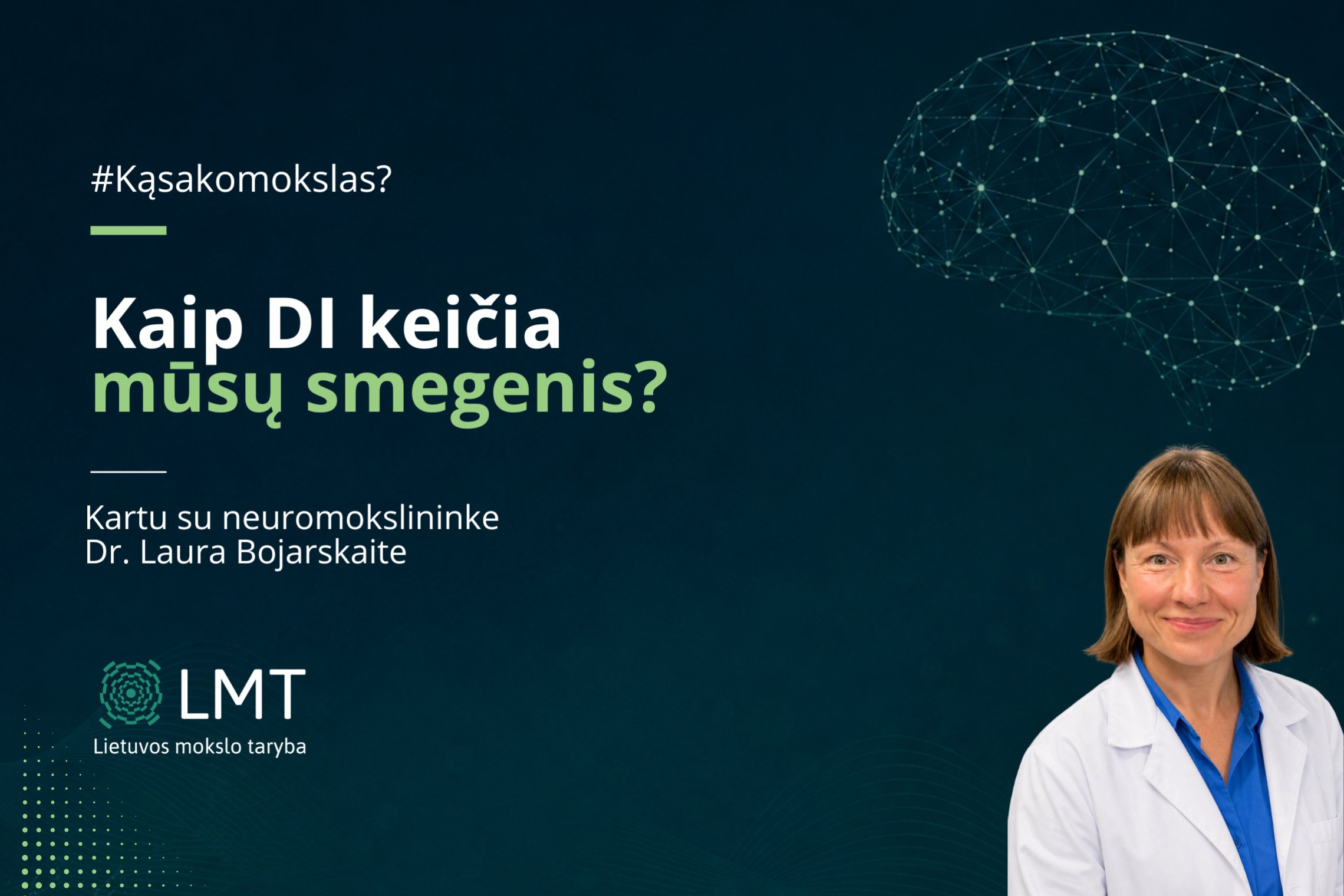
Science is constantly changing the way we understand the world and the processes taking place around us. In the new series “What Does Science Say?” by the Research Council of Lithuania (RCL), we will join researchers in exploring answers to some of today’s most pressing questions, present the latest research and explain complex scientific topics in an accessible way.
We begin the series with a conversation with neuroscientist Dr Laura Bojarskaitė, who has spent more than a decade studying brain function and the effects of sleep on the human body. Today, she is also actively engaged in science communication, bringing the latest research findings to a wider public.
This time, the focus is on a technology that has entered our everyday lives at remarkable speed. Artificial intelligence is already helping us write, learn, search for information and solve problems. But as we entrust more and more tasks to AI, an important question arises: what is happening in our brains in the meantime? Is it changing not only how we perform tasks, but also how we think?
AI is changing not our brains, but how we use them
Artificial intelligence has become an everyday tool for millions of people, prompting growing interest in whether its use can affect how our brains function. According to Dr Laura Bojarskaitė, we can say that AI does have an impact, but this does not mean that it directly “reprogrammes” our brains. The change is primarily related to which cognitive tasks we perform ourselves and how much effort we devote to them.
“The brain is plastic – it strengthens the neural networks that we use regularly. When we try to recall information ourselves, formulate an argument, compare several sources or solve a problem, different brain systems are actively engaged. If we hand this entire process over to AI from the outset, there is less work left for our brains,” the neuroscientist notes.
This process is known as cognitive offloading. According to the neuroscientist, it is therefore important not only whether we use AI, but also at what stage of the thinking process we use it. If we think first and use AI as a discussion partner, editor or critic, we remain active participants in the thinking process ourselves.
Can AI make us lose the habit of thinking?
We often hear concerns that AI may make us “unlearn” how to think. However, according to Dr Bojarskaitė, current research paints a far more complex picture. “The effects are certainly more nuanced than simply saying that ‘AI makes us less intelligent’,” she says.
A widely discussed 2025 MIT Media Lab study, Your Brain on ChatGPT: Accumulation of Cognitive Debt when Using an AI Assistant for Essay Writing Task, asked participants to write essays in three different ways – independently, using an internet search engine, or with the help of a large language model. The results showed that participants who used artificial intelligence recalled their own writing less well, felt a weaker sense of authorship over the text, and exhibited patterns of brain activity that differed from those of participants who wrote independently.
“Other experiments also suggest that writing tasks performed with AI may involve less mental effort. But there is another side to this: a well-designed AI tutor can increase engagement, provide personalised feedback and support learning. AI can become a cognitive crutch when it replaces a person’s thinking, or a cognitive training tool when it encourages them to explain, verify, argue and correct,” says the neuroscientist.
As AI becomes increasingly embedded in our everyday lives, however, Dr Bojarskaitė highlights another potential risk – the weakening of critical thinking.
“What concerns me most is not that we might forget individual facts. The human brain was never designed to store everything. A much more important risk is gradually losing the habit of stopping and asking: Is this true? How do we know this? What is the evidence? What argument is missing here? Critical thinking is not simply about how much we know. It is an active process that needs to be practised regularly,” Dr Bojarskaitė emphasises.
A faster answer does not always mean a better learning outcome
Increasingly, we use AI not because we could not complete a task ourselves, but because we want to do it faster or better. Yet this convenience may also change our learning habits and our relationship with mistakes. AI can provide a fluent and convincing-sounding answer almost instantly. From a learning perspective, however, the neuroscientist points out that this also has a downside: an immediate answer can remove precisely the element of difficulty through which learning takes place.
Learning does not happen simply by receiving the correct answer. Trying to remember, making mistakes, correcting them and trying again all help build more robust knowledge. If we ask AI for the answer before first attempting the task ourselves, we may obtain the result while missing part of the learning process.
On the other hand, AI can show us where we went wrong, provide an alternative explanation or adapt the difficulty of a task. “When learning, I would suggest following this sequence: first try it yourself, then ask AI, then check its answer, and finally explain what you have learned in your own words. AI should help a person stay engaged in the learning process rather than remove them from it,” the neuroscientist advises.
AI, sleep and the assimilation of information
One of Dr Bojarskaitė’s main areas of research is sleep. At present, however, the neuroscientist says there is insufficient direct evidence to suggest that the use of generative AI itself worsens sleep or disrupts the memory processes that take place during sleep.
What is likely to matter more is how AI is used – the amount of screen time, emotional arousal and the absence of clear boundaries. If we use AI before bed to solve work-related problems, plan or generate ideas, the brain remains in problem-solving mode for longer. “A conversation has no natural ending – there is always another question you can ask. Sleep requires not only darkness, but also a psychological signal that the day’s activity has come to an end,” the neuroscientist explains.
Dr Bojarskaitė also highlights another important link involving the memory processes that occur during sleep: “During sleep, the brain stabilises and integrates information acquired during the day, but for this to happen, that information first needs to have been encoded deeply enough while we were awake. If we simply skim an answer provided by AI, do not reflect on it and do not connect it with what we already know, sleep has nothing to magically ‘record’. Sleep helps consolidate learning, but it cannot fully compensate for superficial learning during the day,” the neuroscientist points out.
How can we use AI to help us think better?
When using AI in everyday life, the key is not to reject it, but to learn how to use it in a way that complements our abilities rather than replaces the thinking process itself. “My advice would be very simple: do not ask AI to think instead of you – ask it to help you think better,” Dr Bojarskaitė emphasises.
Before turning to AI, Dr Bojarskaitė suggests first taking a moment to think independently: what do we already know about the problem, what do we think about it, and what are we trying to solve? AI can then be used as a challenger – for example, by asking it to identify weaknesses in an argument, present an alternative perspective or point out potential errors.
It is equally important not to accept an AI-generated answer simply because it sounds confident. Information and sources should be verified, while the final conclusion should remain our own.
“The best formula would be this: the human thinks first, AI assists, and the final decision and responsibility rest with the human once again,” the neuroscientist concludes.
Interview by Domantas Zubrickis, RCL
Photo courtesy of the interviewee’s personal archive
Last updated: 27-08-2026
Related news:
Lithuanian Universities’ Global Networks: How Can They Become a Strategic Asset for the Country?
More Trees in the City – Cleaner Air? According to a Researcher, It’s Not That Simple
RCL delegation explores Finland’s experience with flagship research programmes
Lithuanian Academy of Sciences and Research Council of Lithuania Sign Memorandum of Cooperation