

Terahertz and Hybrid Semiconductor Chips Competence Centre Launches Operations in Lithuania
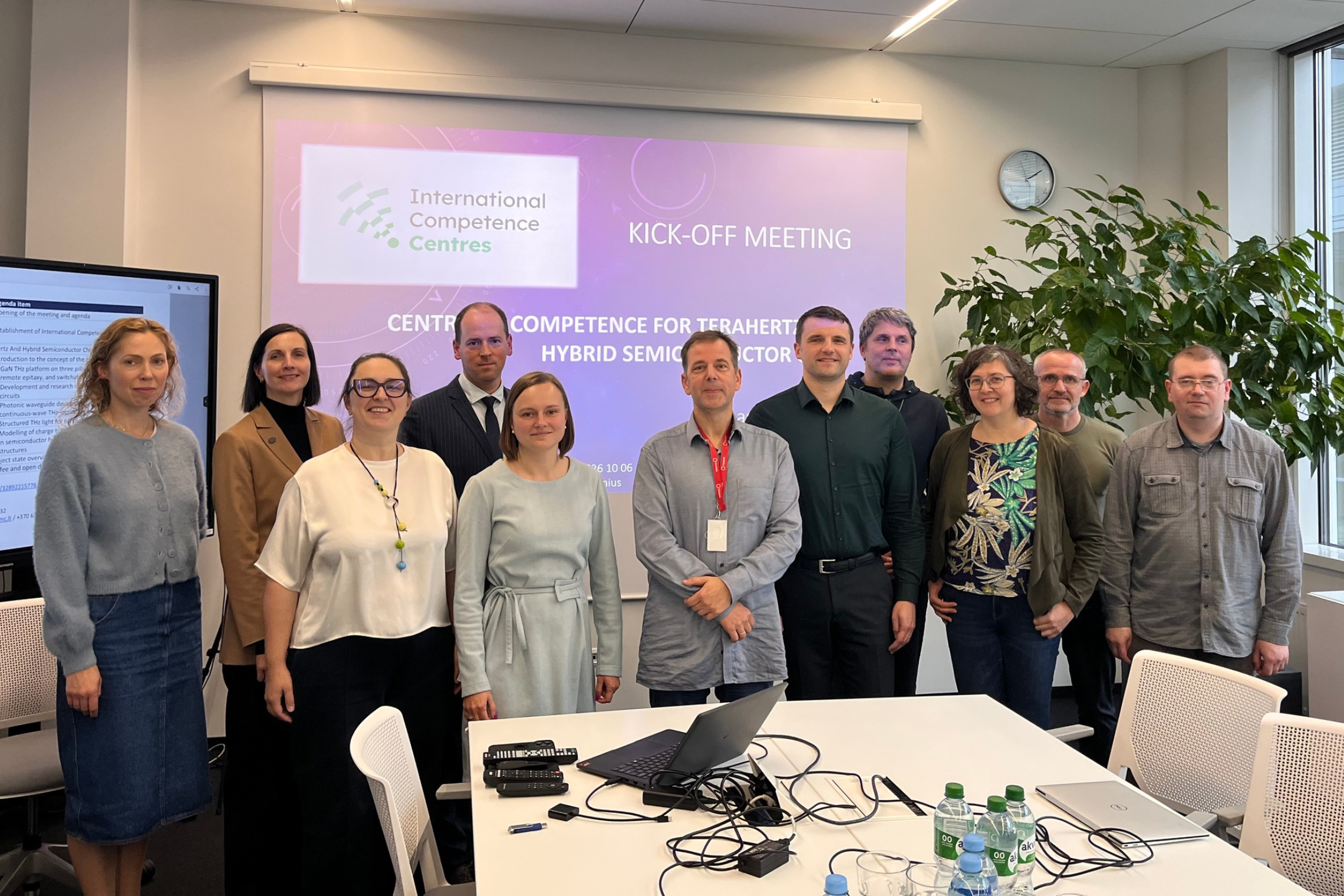
Lithuania is strengthening its expertise in next-generation 6G communication technologies. On 6 October, the Terahertz and Hybrid Semiconductor Chips Competence Centre, jointly established by Vilnius University (VU) and the Center for Physical Sciences and Technology (FTMC), officially launched its activities. At the new centre, Lithuanian researchers will work with international partners to develop advanced semiconductor chips, materials and components essential for next-generation communication systems.
New Opportunities for Future Communication Technologies
As data volumes continue to grow and demand for faster, more efficient connectivity increases, greater attention is being paid to technologies that could form the foundation of future 6G communication infrastructure. One of the most promising areas is terahertz technology, which offers the potential to transmit exceptionally large volumes of data. However, its practical application requires new semiconductor components, integrated circuits and advanced technological solutions.
To address these challenges, the new centre will bring together expertise from different research fields, ranging from semiconductor materials research and ultrafast process modelling to photonic chips, terahertz signal control and the development of integrated communication systems.
Five Research Groups Working Towards a Common Technological Goal
The new centre will comprise five research groups whose activities will cover the 100–340 GHz frequency range. Each group will focus on a distinct technological area, with their results integrated into a shared terahertz communication technology platform.
The group led by Prof. Dr Alvydas Lisauskas at VU will develop terahertz integrated circuits, including detectors, mixers, frequency multipliers and receiver circuits. The research will also aim to integrate chips manufactured using different technologies into a single system and demonstrate high-speed communication solutions under laboratory conditions.
Researchers led by Dr Sergejus Orlov at FTMC will investigate the application of structured terahertz light in 6G communications. They will develop active metasurfaces capable of controlling electromagnetic wave propagation and shaping beams with specific properties. One of the planned objectives is to demonstrate a terahertz communication link extending over more than 100 metres.
The FTMC group led by Dr Armandas Balčytis will develop photonic waveguide technologies for terahertz-to-optical communication conversion. Researchers will create photonic chips capable of connecting fibre-optic and terahertz communication systems, enabling more efficient data transmission.
The group led by Dr Agnė Žukauskaitė at VU will develop a gallium nitride (GaN)-based platform for terahertz technologies. Researchers will investigate advanced semiconductor nanostructures and transistors designed to generate, detect and modulate terahertz waves.
The VU group led by Dr Patrik Ščajev will focus on modelling charge transport and ultrafast processes in semiconductor materials. This research will contribute to a better understanding of material properties and the development of more efficient terahertz signal detectors and other components.
All five groups will work towards a common objective: achieving Technology Readiness Level 5 (TRL 5), at which the technologies and their components have been validated in a relevant environment. This will help create the conditions for research results to progress from laboratory-based solutions towards practical applications.
Technological Prototypes, Patents and New Jobs Planned Over Three Years
The centre's activities are planned over a three-year period, during which researchers aim to progress from developing individual technological solutions to integrating them into a unified system.
The first year will focus primarily on developing technological models and investigating materials and components. During the second year, component prototypes will be developed and tested, while the third year will focus on creating an integrated technology platform and demonstrating the operation of a terahertz communication link.
Over this period, the centre's researchers plan to file at least eight European patent applications and publish a minimum of 20 peer-reviewed scientific papers. The centre also aims to strengthen the competencies of early-career researchers, attract new specialists, and create or fill approximately 40 positions.
The ambition is to ensure that the technologies developed at the centre extend beyond laboratory research and, in the longer term, create opportunities for high-value-added products, promote technology transfer and strengthen cooperation between Lithuania's research community and industry.
International Partnerships and Ambitious Three-Year Objectives
International cooperation will be an important part of the centre's activities. Plans for its establishment include collaboration with Eindhoven University of Technology (TU/e, the Netherlands) and imec, a research and innovation centre specialising in nanoelectronics and digital technologies (Belgium).
These partnerships will enable Lithuanian researchers to exchange knowledge and experience, benefit from international expertise and strengthen their participation in European research and innovation networks.
An International Advisory Board is also planned for the centre, bringing together representatives of foreign research institutions, the Research Council of Lithuania (RCL), and the ministry responsible for education and research policy.
Centre's Research Priorities Presented at the Project Kick-off Meeting
The project kick-off meeting, held on 6 October, focused on the centre's main research areas, three-year activity plans and opportunities for cooperation.
The meeting was chaired by the centre's director, Prof. Dr Linas Minkevičius. RCL representative Julija Baniukevič presented the broader project for establishing international competence centres, while VU Vice-Rector for Research, Prof. Dr Habil. Gintaras Valušis, introduced the scientific concept behind the new centre.
The meeting highlighted the ambition to bring together research expertise, strengthen international cooperation and create the conditions for the practical application of the technologies being developed.
Long-Term Goal: A Sustainable Research and Innovation Ecosystem
The activities of the Terahertz and Hybrid Semiconductor Chips Competence Centre are designed to generate long-term benefits for Lithuanian research, technological development and the high-tech sector.
Following the completion of the project, the centre is expected to continue developing through joint activities between VU and FTMC, maintaining cooperation with international partners, attracting funding from European Union and national programmes, and implementing collaborative projects with industry.
The centre is expected to contribute to the internationalisation of Lithuanian research, strengthen expertise in advanced semiconductor technologies and create new opportunities for Lithuanian researchers and innovative businesses.
The establishment of the centre is part of the European Union co-funded project Establishment of International Competence Centres, coordinated by the Research Council of Lithuania (RCL).
The activities of the Terahertz and Hybrid Semiconductor Chips Competence Centre are funded under the project “Establishment of International Competence Centres” (No. 10-030-P-0001). The project is co-funded by the European Union.
Last updated: 29-10-2026
Related news:
Lithuania Co-Organises the GRC European Regional Meeting for the First Time
Lithuania and Taiwan Strengthen Cooperation in Laser Technologies